
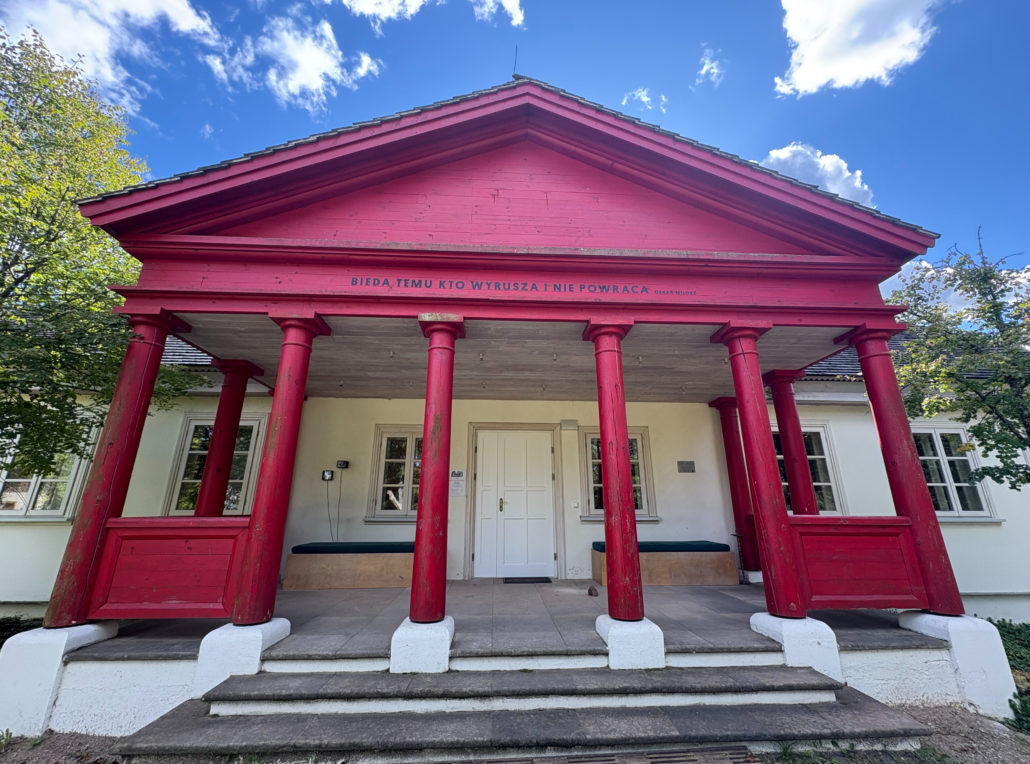
Translation: The Power to Shape Recollection & Relationships
By Sarah Mowrer
One of the most daunting aspects of traveling to a foreign country is being unable to speak or understand the native language. This obstacle, however, was sidestepped in my education during the travel seminar through Poland due to a powerful tool: translation. The recollection of the diverse identities, cultures, and historical narratives of Poland can only be properly disseminated to a broad range of recipients through translation. Translation is also relevant in the discussion of identity due to the country’s multicultural historical background. From about the 16th to the 18th century, the country was the dual state of the Polish-Lithuanian Commonwealth. Furthermore, prior to the Holocaust, ethnic cleansings, mass migration and forceful displacement of populations during and after WWII, Poland’s populace comprised of multiple substantial minorities: Ukrainians, Jews, Belarusians, Germans, and Lithuanians. In varying contexts, translation is consistently a buttress for forming connections, shaping memory, and history education.
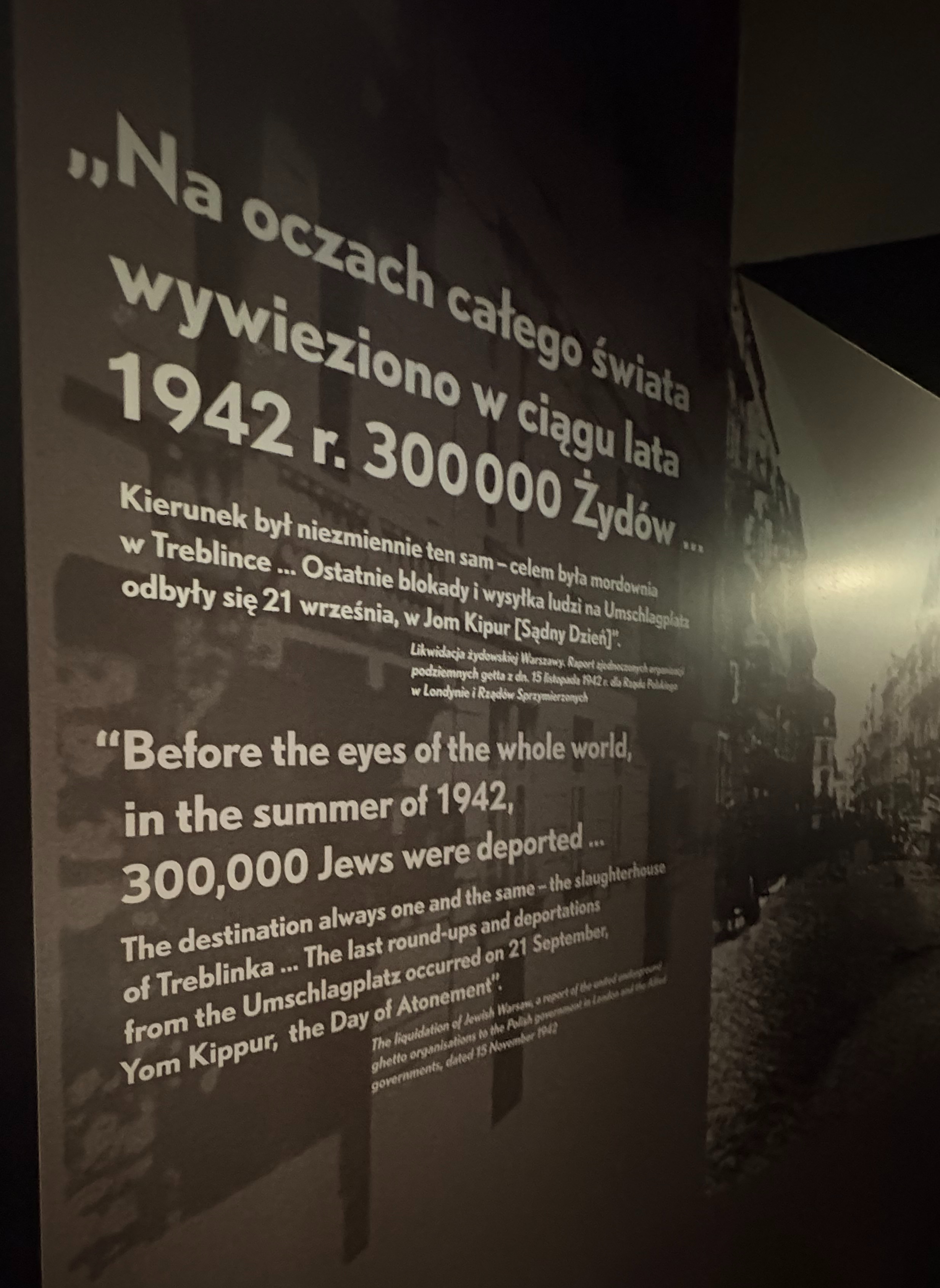
Information in POLIN Museum
Museums are common to visit for each location we travel to. It is in these institutions where one of the most pervasive applications of translation appears: English descriptions. Throughout the entirety of the Warsaw Rising and POLIN museums in Warsaw and the Museum of the Second World War in Gdańsk, Polish descriptions are accompanied by their English translations. This addition is in the context that these are prominent museums located in major cities of Poland, therefore drawing in many foreign tourists. The choice to specifically have English translations is due to English’s position as a global, mutually known language broadly used for international communication. However, translation extends beyond English. Audio guides lead you through the museums and are provided in a variety of languages. For instance, the Museum of the Second World War offers 10 different audio guide languages. Warsaw Rising offers 7 languages. POLIN offers the most at 12 and even has a Polish Sign Language option. The audio guides provide the museums with the opportunity to capture interest and educate visitors on a greater international level. Additionally, it’s an important tool to avoid excluding those who speak neither Polish nor English—especially those whose ancestral history is told in the museums.
 Beyond the cosmopolitan feel of cities and their well-established museums, translation also plays a key part in the rural areas of Poland. Our travel seminar took us to the town of Sejny and the nearby Krasnogruda Manor House. These sites are located near the Lithuanian border (in fact we drove past a border demarcation) in a historically “borderland” region. Borderlands describe a region impacted by the constantly shifting borders of former empires and involve the meeting of different cultures on the periphery and tensions with identities that tend to be more fluid in nature due to the blending of populations and traditions. The Krasnogruda Manor House is home to the Borderland Foundation, an organization that supports open dialogue between locals with diverse cultural identities in order to create a space of mutual coexistence. With a multiethnic population, the area is home to more than one language. Many inhabitants are Polish and Lithuanian speakers. Prior to WWII and the Holocaust, Sejny also had a substantial Jewish population for hundreds of years, meaning Yiddish was also spoken prominently in the past. This multilingual identity of the region is represented at the Manor House. One room had a descriptive plaque written in Polish and Lithuanian. Small pages of poetry hang on the walls, open for visitors to take with them. I took one translated to English; hanging beside it was the same poem, but in German. The presence of poetry is due to the former patron of the Manor House, Czesław Miłosz, a Nobel Prize winning poet who wrote mainly in Polish (although he was born in Lithuania) and whose family originally owned the Manor House.
Another locale for poetry on the property was Cafe Europa. In the evening, our group was joined by Polish university students for a poetry reading event. The conduction of this gathering was a unique experience for me. A large part of the event’s impact was due to the poems being read aloud in their original language and then in English if there was an available translation. This event felt special since my group and I could actively participate in the translations by reading poems in English ourselves after their presentation in Polish, instead of it merely being presented to us. However, some poems lacked translation, so I had to rely on vocal intonations. With this limitation, I was able to simultaneously renew my appreciation for translation and pay greater attention to the Polish language. There was an emphasis on enjoying a poem in the language intended by the poet. The significance of this choice reflects the role of translation–crossing language barriers to freely share information–without undermining the original language. For example, one poem we heard through a video in Ukrainian, delivered by the poet himself, a Ukrainian soldier who later died fighting in the Russo-Ukrainian War. Listening to Ukrainian poetry, made more tragic by the poet’s death, defies the Russian invasion’s attempt to subsume Ukraine. In another instance, Hania from our program group read aloud a poem in its original Belarusian, a language that has been dying out among native Belarusian speakers in favor of Russian under the current policies of the Lukashenko regime. Therefore, in reading the poetry in Belarusian, Hania was embracing and keeping alive that aspect of her identity despite the existing political efforts for the language’s erasure.

Old Town, Warsaw Plaque

Saxon Garden Plaque
Hania’s poetry reading shows how language is intrinsically tied to identity. The national Polish identity as seen through language can be observed in memorials located throughout Warsaw. Traveling through Poland means confronting the historical tragedies that have occurred during Nazi and Soviet occupations. One memorial plaque, found in the rebuilt Old Town, celebrates the massive rebuilding efforts in Warsaw following its almost complete destruction during WWII. . Another in the Saxon Garden commemorates the 6 million Polish citizens who perished in WWII. A plaque near the Presidential Palace mourns the loss of President Lech Kaczynski, who died in a plane crash while flying to the site of the Katyn massacre for its 70th anniversary ceremony in 2010. What all three have in common is this: they are only in Polish. The absence of a translation indicates that the message within is fundamentally directed toward a specific cultural group who speaks the same language. While translation implies reaching a greater range of remembrance and educating a larger audience, the lack of it implies a targeted identity: a national Polish-speaking population. This narrowly defined “Polish” audience naturally excludes the alternative realities of different groups. For example, in the instance of the Saxon Garden memorial, the Jewish identity of about half of the victims, solely identified as Polish, goes unmentioned. This erasure, combined with there being no other language than Polish, diminishes the suffering of Jewish victims in favor of representing a dominant, monocultural Poland.
Opposing this monocultural view of Poland is the reality of identity in Poland further in the past, which was more openly multicultural. Evidence of this diverse past can be seen in the gravestones of the Jewish cemeteries in Krakow from the late 19th and early 20th centuries. Many gravestones have three inscriptions. Each inscription is a translation: one in Hebrew, one in German, the final in Polish. A person living in Krakow at this time could have multiple identities, with each language representing a different facet. Yiddish was the common language of the streets; German was the official language of the state, Austria-Hungary; Polish was the language of the greater community of Kraków. With all three major languages represented, it granted everyone from the area the ability to decipher the gravestones and show belonging to multiple communities.
During my travels, the role of translation was not confined to written language. Some of the most impactful lessons of the travel seminar came from guest speakers who are locals from the area. Here, one of the biggest obstacles in education when traveling abroad became apparent: not all the guest speakers spoke English. This is where live translators shone through to support my experiences in Poland. Juliet, both a professor and the director of the program, also fulfilled the task of translation for us. The guest speakers could deliver their lectures in Polish while Juliet translated to English as they spoke; she also translated any questions the group had for the speakers. A guest speaker in Sejny profusely thanked Juliet at the end of her lecture. She emphasized her trust in Juliet’s translation capabilities to accurately convey her thoughts to us. Truthfully, her recognition of Juliet’s efforts was the moment that the importance of translation became very apparent to me, and I carried this realization with me on the rest of my travels. Additionally, her mention of trust stresses how delicate translation can be in conveying specifics that could be lost without sufficiently competent translators.

Kamienica Wall, Warsaw
Guides are another valuable avenue of insight into topics that would have otherwise been lost to me without help translating meanings. For instance, Professor Gerbert, while leading us through the area of the city that was once the Warsaw Ghetto, noted the inscription of “kamienico” on a wall that had survived until today from before WWII. According to him, “apartment buildings” is the direct translation. However, he noted, by breaking up the word at the letter “n”, its meaning transforms into the message “stone, and then what?”. This play on words is meant to convey the lost place of ruins such as that crumbling wall in the current city of Warsaw, a theme that became evident throughout the former ghetto area, which has been rebuilt anew with modern structures. The deeper meaning, which delves into complex topics such as the physical presences of historical memory in Warsaw, thus stands as an example of how imperative translation is to begin to understand the spaces we occupy.
In summary, I discovered the vital ability of translation to allow for communication across linguistic, and therefore cultural, boundaries in the varied contexts of the travel seminar through Poland. It empowers connectivity on the levels of individuals, local communities, and internationally in present-day relations. Additionally, common recollection of the past is eased with translation between nations with shared history and for foreigners with lacking prior knowledge such as myself. As long as effort is put into creating translations, it can be sure that knowledge and bridge-building efforts will be spread across diverse communities.

