
Beyond the Legend: Beloved City Symbols Warp the Narrative
By Ella Roerden
Worldwide, regions of all sorts have recognizable symbols they claim as their own. Oftentimes, these symbols are some type of animal or creature. In most cases, these symbols have become sources of pride for the residents of any given place: something to unify behind. Residents tend to feel that these figures represent them as a people, and over time, legends circulate to explain their origins and their connections to the place. In the West, especially in the United States, these symbols are usually found in the form of mascots, connected to various calibers of sports teams. Cities from coast to coast rally behind mascots of all varieties of sports, from American football to ice hockey. In other countries and cities, for example, in a few notable cities in Poland, mascots or motifs emerge that usually have less to do with sports and more to do with tourism and capitalizing on a symbol that distinguishes them from everyone else. But whether it’s a sports team mascot or a local tourism symbol, there’s one thing that these icons frequently (though not always) have in common. They focus on a positive facet of the history of a place and direct all attention to it. In doing so, they gloss over other aspects of local history and shape the narrative to suit the image those in power want the world to see. The “dark” or “secret” histories of places fall away, forgotten, as the symbols and the messages they project take over.
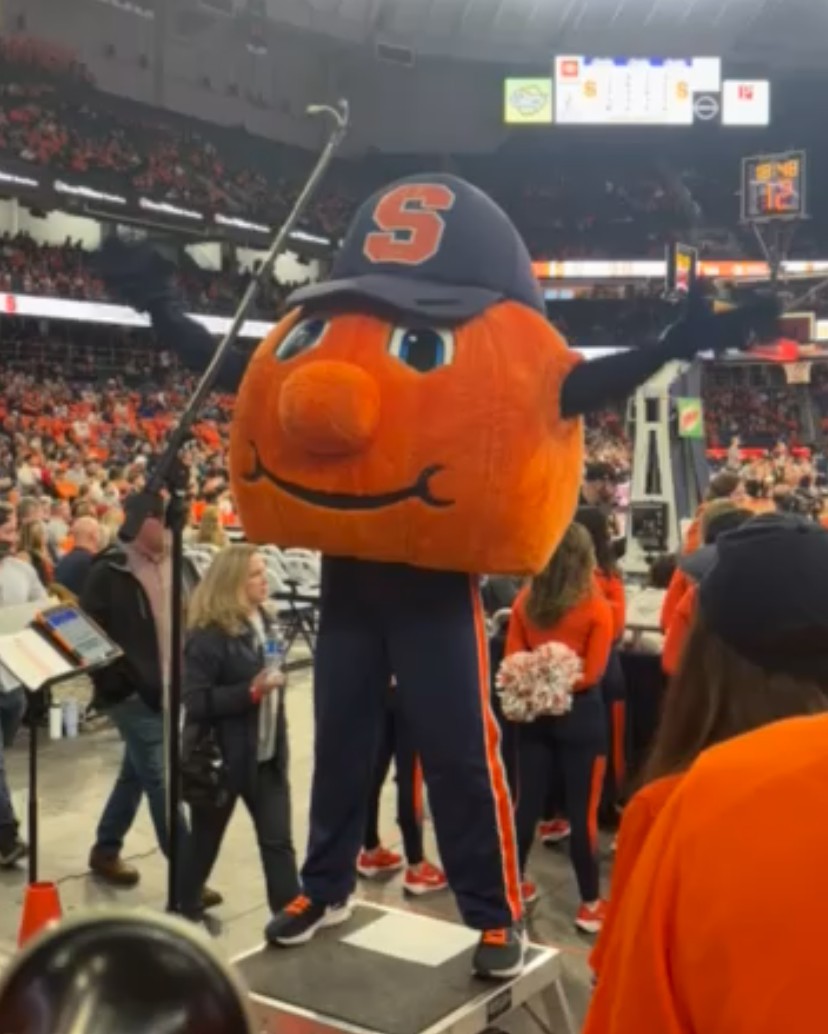
Otto the Orange. Photo credit: Ella Roerden
In the US, sports mascots are major signifiers of pride. At Syracuse University, my home institution in my hometown, the beloved mascot “Otto the Orange” has become a huge symbol over the decades. While various other mascots were considered over the years, the Syracuse community came together in support of Otto in 1990. Otto the Orange became Syracuse University’s official mascot, and both the university community and the city of Syracuse and surrounding region of Central New York State vibrantly adopted Otto as their own. Though Otto only became official thirty-five years ago, it’s as if Otto has always been there. Nobody remembers a time before Otto.

Wawel Dragon. Photo credit: Ella Roerden
In Europe, particularly the Polish cities of Krakow and Wroclaw, similar patterns surrounding local mascots can be found. In Krakow, a recurring symbol is the Dragon of Wawel Hill. The dragon, according to legend, lived in the cave under the hill upon which Wawel Castle now stands. There are several versions of the tale, as is so often true with legends passed down through generations. Among them, the important part remains the same: the dragon was vanquished, through might or cleverness, and Krakovians are happy to claim that as part of their heritage. It makes Krakow seem powerful and strong, dominant. Anywhere you look in Krakow, you’ll find dragons, in the form of statues and souvenirs. Clearly, Krakow and its residents have latched onto their dragon as a tourist trap.

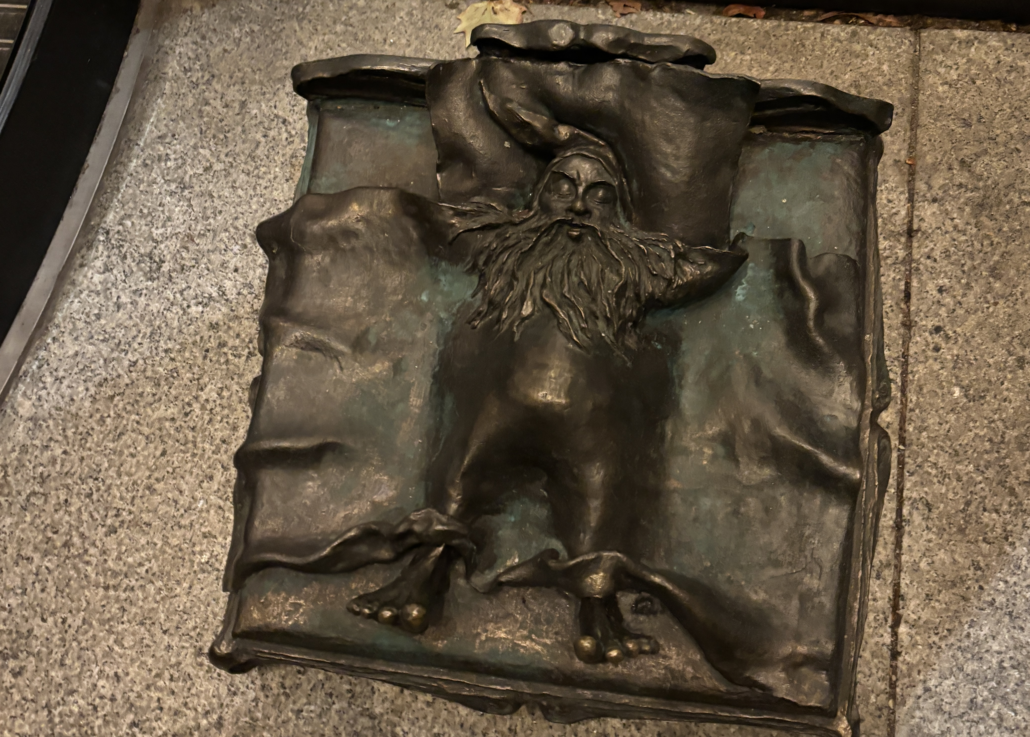
Gnome sleeping in bed. Photo credit: Ella Roerden
A very similar phenomenon exists in Wroclaw, where more than a thousand miniature bronze gnome statues dot the city. Each one unique, they can be found in every part of the city. Public and private entities can pay to have a customized gnome installed outside their doors, such as a gnome sleeping spread-eagle on a tiny bed outside a hotel on the outskirts of Cathedral Island, or one reading a book from a stack by the main entrance to the University Library. These gnomes are a specific project launched by the local government to distinguish the city, especially in the post-communist era when there has been a focus on boosting tourism.
In each of these three cases, Syracuse, Krakow and Wroclaw, cute, recognizable mascots play a significant role in the cities’ identities and in building local pride. These symbols also serve to bring in more money for each given city, and to unify the people who live there. But, as much as local authorities may want you to believe it, that isn’t the end of the story. The light, fun atmosphere created by Otto, the anthropomorphic orange, a toy-sized gnome, or a fire-breathing dragon, all push a narrative of there having only ever been blatant positivity extant in these cities. They leave no room for a more dynamic, layered, and often darker history.
In Krakow, there isn’t one very specific “troubled” event from history that is tamped down by the dragons, but certainly none of the legends associated with the Dragon of Wawel Hill as an origin myth for the people of Krakow are true. They do also downplay a lot of what actually happened in the past. Attributing the founding of a city to one or two individuals who defeated a dragon belittles the contributions of many people who were equally involved in the long, multifaceted work of building a city from the ground up. While grander tales of dragons and dragon slayers were more easily passed down orally into the present, the histories of those involved in the real founding of the city, who lived and died hundreds of years ago before the written record, have been forgotten. The true side of the story is less marketable when the alternative is a fearsome dragon.

Book gnome. Photo credit: Ella Roerden
In Wroclaw, the history hidden behind the innumerable dwarves is deeper and darker than that of Krakow’s dragon. The symbol of the dwarf, or gnome, emerged in Wroclaw during an anti-Soviet, anti-totalitarian movement in the 1980s called the Orange Alternative. One of the main actions of this movement, known for attacking communism with satire, was to paint innocent, cute, funny gnomes over top of the gray paint the Soviet-backed regime used to cover anti-communist graffiti. Activists felt it would be silly for the Soviets to cover up such benign symbols as a gnome that wasn’t offending anyone. The Orange Alternative ran with this gnome idea, progressing to wearing pointy orange gnome hats during their street protests. The use of gnomes made these protests a much less scary place to be, thereby more accessible to the general public, many of whom ordinarily would refrain from more traditional forms of protest out of fear. The gnomes became a symbol of hope, both for the city of Wroclaw and for Poles across the country, that not everything was lost, and that by coming together, they could fight back against totalitarian Soviet rule.
In the modern day, the city government alarmingly long denied the Alternative’s gnomes being the inspiration for the contemporary promotional mascot and intentionally distanced itself from the anti-communist movement. It specifically tried to make sure that such a group of dissidents, people fighting the government (even the now-scorned Communist regime), practicing civil disobedience, would not easily be remembered. Eventually, a court intervened and found that the intellectual rights of the original artists had been infringed upon. Prior to that, the local government took the cute, friendly dwarf symbol and claimed it as its own with no acknowledgement that anything “untoward” or “unseemly” ever existed or had anything to do with Wroclaw.
This brings us back to Otto the Orange and other sports mascots. These fuzzy, huggable icons sometimes hide a more shameful past. Like the gnomes in Wroclaw, the promotion of symbols is used to cover up the parts of history that local authorities don’t want the general public to know about. In particular, so many sports teams in the United States have mascots that portray Indigenous people in distasteful and offensive ways. Of course, these teams are not made up of Indigenous people, and the use of these people or symbols are not only senseless, but also disrespectful, given the history of European colonization in the Americas, which was so detrimental to the Indigenous groups. The effects of this colonization live on as Indigenous Americans today largely do not have the rights or recognition they are due. To destroy the culture of a people so vehemently for so long, and then to take their images or names and use them for profit for a team is fundamentally wrong.
Over the decades, voices of public dissent have emerged and led to change. Some mascots have been replaced with non-offensive options. But the shame lingers, and usually, marketing departments are eager to promote the new ones, and enable the old ones to be collectively forgotten. That very thing actually happened in Syracuse. Otto the Orange’s predecessor was Syracuse University’s Saltine Warrior. The origins of the mascot date back to the 1930s, when rumors appeared that the historic remains of a local Indigenous chief were found on campus during construction of a new building. The subsequent mascot was based on this finding. The Saltine Warrior was supposed to resemble a fearsome Indigenous chief, but really was just a stereotyped caricature. In the 1970s, this mascot was protested by an Indigenous student group, and the search for a new mascot began, finally culminating with Otto in 1990. Since then, Syracuse has been “all orange,” all the time. The Saltine Warrior is almost completely forgotten, nearly gone from the minds of those who once represented it, because of the shame in knowing they did something wrong and got called out for it. It’s another clear example, just like the dwarves and the dragons, of how strategic marketing and promotion of beloved mascots as local symbols can be used to completely rewrite the narrative, and all but ensure that selected aspects of true history are forgotten.
References:
- Cervinkova, H. (2013). The kidnapping of Wroclaw’s dwarves: The symbolic politics of
neoliberalism in urban East-Central Europe. Sage Journals. https://journals.sagepub.com/doi/10.1177/0888325413488627 - Dolinsek, S. (2011). Survival of the citrus: SU weeds through weak crop of mascots, grows a real
winner with Otto. The Daily Orange. https://www.dailyorange.com/2011/11/survival-of-the-citrus-su-weeds-through-weak-crop-of-mascots-grows-a-real-winner-with-otto/ - Stanley, A. (1999). The stones of Poland’s soul. New York Times Magazine.
https://archive.nytimes.com/www.nytimes.com/library/magazine/millennium/m4/ - Syracuse University. Campus Traditions. https://www.syracuse.edu/about/history/traditions/

