

Quantifying Tragedies: What Happens When You Tell Rather Than Show
By Sarah Vallejo
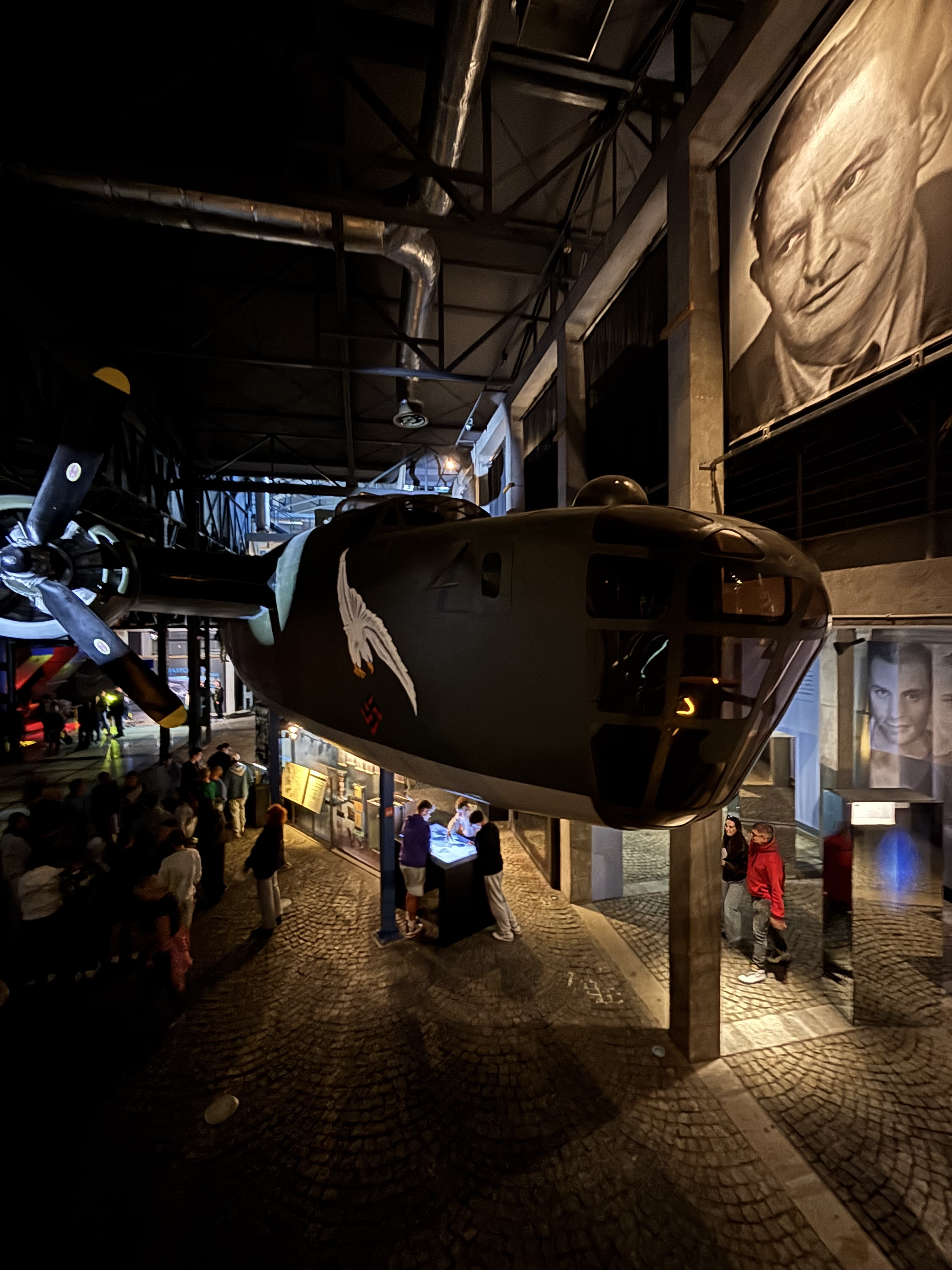
One of the main exhibition halls at the Warsaw Rising Museum. People and their stories are at the center of the museum, as shown by the numerous portraits present in this image. Photo credit: Sarah Vallejo
Tucked away at the end of the Warsaw Rising Museum is a 3D film called City of Ruins that doesn’t quite match the flow of the museum up to that point. Prior to this film, the museum weaves a complex narrative of resistance, death, power, and destruction that made up the 1944 Warsaw Uprising led by the Polish Underground. The museum is filled with victims’ and survivors’ photographs, clothes, letters, and more that show the stories of the individuals fighting for liberation. City of Ruins pulls the perspective back, taking the viewer on a digitally reconstructed aerial viewing of Warsaw. The city is in complete ruins. Without understanding the historical complexities of Warsaw’s destruction during the war, it could be difficult to decipher that the video is in fact showing the viewers the city of Warsaw as it looked after the Warsaw Rising. Throughout the film, statistics flash over scenes of destruction: “On September 1, 1939, Warsaw has 1,300,000 inhabitants,” “On August 1, 1944, there are 900,000,” and “After the fall of the Warsaw Rising no more than 1,000 people live in the ruins”1. These statistics are jarring, in part because of what the horrifying numbers mean, but also because few other spots in the museum use statistics to tell the tragic outcome of this event. The curators of the Warsaw Rising museum heavily rely on first-hand accounts to show how the Warsaw Uprising unfolded and almost avoid the use of statistics entirely.
When used correctly, statistics and numbers can ground historic events, but when improperly applied, they can completely overwhelm the narrative, taking away the personal aspects of these tragedies. I believe the Warsaw Rising museum was attempting to avoid overpowering the human experience of the uprising. Rather than relying on numbers to tell the story, the curators wove together probably hundreds of individual stories to shape the larger narrative.
While some might say that the numbers are a useful tool in “gauging” the scale of an event, I believe that these statistics completely take the individuals out of the horrible circumstances they were in and what they lived through by reducing them to a data point. In an online meeting with fellow Syracuse students conducting international research, I spoke with a student in Chile studying the atrocities of Chile’s Pinochet dictatorship who expressed a sentiment that encapsulates my stance: “While […] statistics are horrifying, the numbers can inadvertently mask the complexity of what happened and serve to further anonymize victims”3. She was referencing the human rights violations prevalent in Augusto Pinochet’s dictatorship, but the idea remains true for all large-scale tragedies. Historian Brian Porter-Szucs makes a similar point in Poland in the Modern World. No matter the number, he wrote, “[e]ach death was an individual tragedy.”4 When faced with a figure like 1,300,000 or 1,000, it’s easy to forget that this isn’t just a number. Behind the numbers are individual people who suffered, fought, and lost so much. Entire communities were exiled or murdered. The lives of families and their stories are lost in the numbers. What’s worse, they are remembered for how they died or the worst experience they lived through, not for how they lived their lives prior. Those chapters in their biographies are lost.
But this loss isn’t due to a lack of empathy. In fact, the human brain actually can’t process such large numbers2. While it varies by the individual, the average person can generally picture numbers up to about 40. Asking a person to visualize 50 people is a challenge, so asking them to grasp what a million deaths means is incredibly abstract and not feasible. Humans do not have the capacity to see large numbers and wrap their heads around their significance2. They cannot see the blood, tears, struggle, hope or tenacity that these numbers hide or conceal. Thousands of people get reduced to one number, and to even be digestible, the number must be related to something well-known. With larger numbers, the human brain is useful when thinking solely about comparisons2. In other words, the brain can only understand: which number is bigger or smaller; which group lost more; which tragedy is “more tragic”? Porter-Szucs uses comparisons to illustrate Poland’s losses during World War II: Poland’s losses today would be the equivalent of the UK losing all of London and greater Manchester’s combined populations or the USA losing all the inhabitants of California, Oregon, and Washington4.

The plaque commemorating the six million fallen Poles of World War II in Saxon Gardens, Warsaw. Photo credit: Sarah Mowrer
In addition to anonymizing victims, numbers can also be used to blur the narrative. In World War II statistics, everything is an estimate. Depending on who is telling the story and the message they want to convey, the estimates can be on the smaller or larger end of the accepted range. These estimates can also gloss over important details and, as a result, lose complexity by omitting certain pieces. A prime example of such an omission can be found in an unassuming memorial plaque lying on the edge of Saxon Gardens in Warsaw that is a relic of its time. In 1965, the commemorative plaque was unveiled6. It memorializes the six million Poles who died in World War II, including 800,000 from Warsaw, but it makes no mention that most of those Poles were Polish Jews. Under Soviet influence, attempts were made to remove ethnic belonging from conversations about the Holocaust, opting instead to focus on unifying Poland against the Nazi aggressor. One could argue that the idea of removing statistical breakdowns of race, ethnicity, or religion from the numbers is a positive thing. When speaking of statistics, Porter-Szucs wrote that as historians, we should be careful not to fall into the trap of speaking about those who died in the Holocaust in the same way the Nazis did – dividing them by race, religion, ethnicity, or sexuality4. But it would be naïve to say that this was the communists’ reasoning for omitting the details of who those six million Poles really were. They didn’t “happen” to be Jewish as the communists might have wanted people to believe; their ethnicity was a crucial part in why the Nazis did everything that they did, and the Soviet-era monument is clearly a politically motivated effort to remove a key factor that explains why so many Poles died in World War II. It is a great example of how numbers never show the full story, they can only tell part of it.

Quote at the exit of Yad Vashem’s exhibit in Auschwitz in Polish, Hebrew, and English. ‘It happened, therefore it can happen again: this is the core of what we have to say’ by Primo Levi. Photo credit: Sarah Vallejo
So how do you show the scale of a tragedy without anonymizing the victims or blurring the narrative? I think one exhibit at Auschwitz, in particular the Book of Names project, strikes this balance as well as you can. The project is located in Block 27 of Auschwitz I and is curated by Yad Vashem, Israel’s official memorial institution to the victims of the Holocaust. When you first walk into Block 27, you’re met with a room covered in wall-to-wall video projections showing Jewish life in Europe before the war along with the name of the country each video is from. You see snippets of Jewish life in Czechoslovakia, Belarus, the Netherlands, Finland, Poland, and many other places. I found it incredibly moving to be surrounded by snippets from ordinary pre-war life – people swimming at the beach, kids playing with each other behind their houses, families celebrating birthdays, etc. It’s a stark reminder that these were just people with no sinister motives like the Nazi Regime wanted people to believe. In sharp contrast, the next room shows propaganda films of top Nazi officials using fear to spread antisemitism and lies about the Jewish communities. In the following room, a large map shows the location of killing centers and mass execution sites. Other displays give statistics to show how many Jews lived in these locations prior to the war, and how many were murdered in the Holocaust.

Estimated number of Jews deported to Auschwitz, broken down by country. Photo credit: Sarah Vallejo
The Book of Names is in the final room of Block 27, which is part of an ongoing project carried out by Yad Vashem to identify Jewish persons who died in the Holocaust. The Book of Names is large and contains around 4.8 million names of men, women, and children, and more are being added as they’re discovered5. The installation spans the length of the room, and the pages are tall and double-sided with relatively small font to fit the names of the millions of Jewish people who suffered in one space. When known, the places and dates of where a person was born and died are included alongside their name. In Yad Vashem’s own words, “The Book of Names actualizes the inconceivable number of Holocaust victims”5.
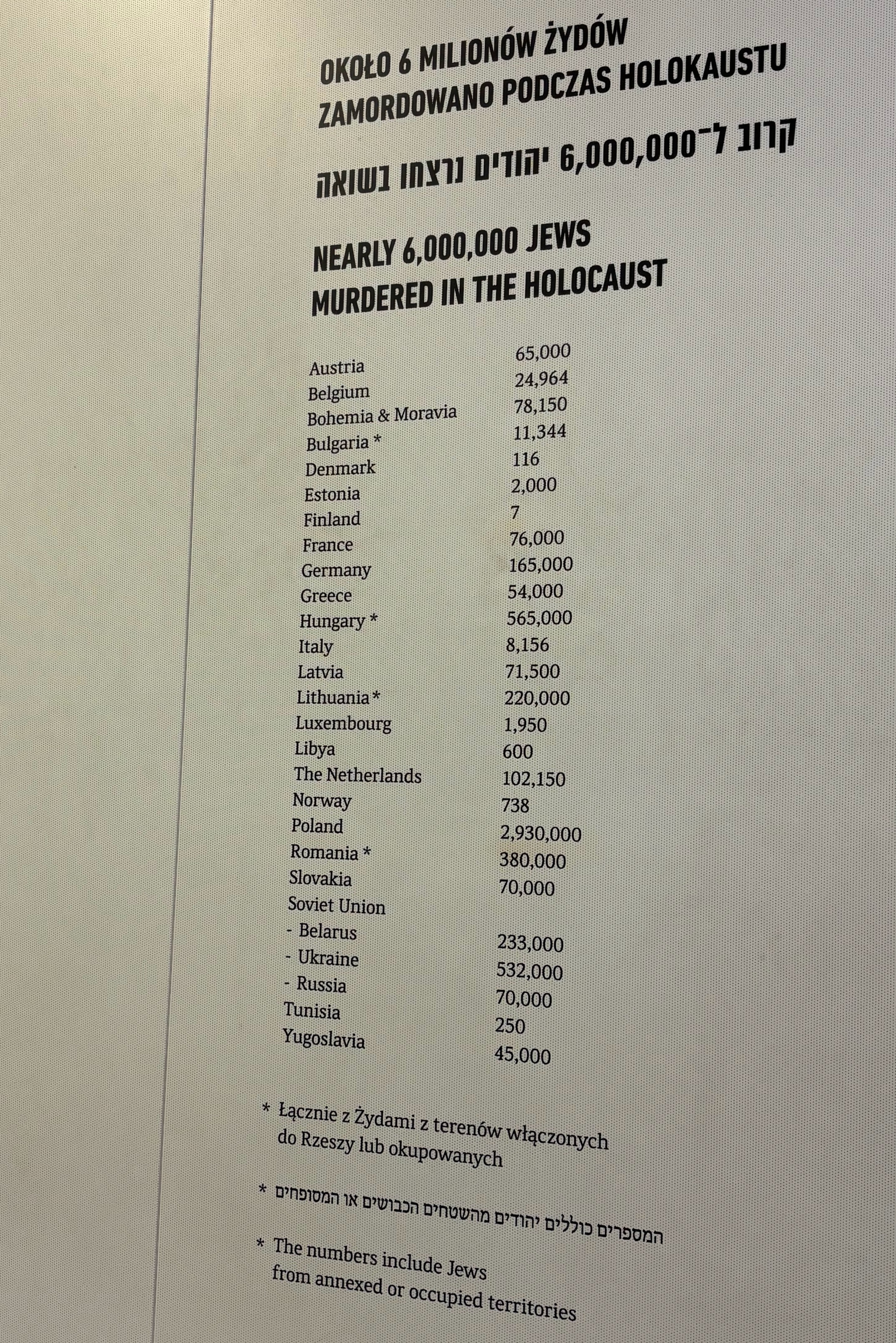
Nearly 6 million Jews murdered during the Holocaust.’ This wall statistic highlights estimates for how many of these murdered Jews came from each of the listed countries. It shows how widespread Nazi power had spread and that few European countries were unaffected by the Nazi agenda. Photo credit: Sarah Vallejo
It’s hard to visualize the massive scale of the Holocaust, but seeing victims’ names is a powerful start in remembering that these were real, ordinary people leading real, ordinary lives before the war, as emphasized by the videos shown in the beginning of Yad Vashem’s exhibit. Visitors often instinctively look for names of people they knew, family names, or well-known victims like Anne Frank. The Book of Names serves as a quasi-headstone for all those who were murdered and disregarded by the Nazis, and it is incredibly powerful. While the stories of all six million Jews who died in the Holocaust may never be known, knowing who they were – even just their names – is better than seeing a simple number.
Sources:
- City of Ruins. Directed by Damian Nenow, executive producers Jarosław Sawko, Piotr Sikora, Tomek Bagiński, Platige Image, in association with the Warsaw Rising Museum, 2010. Platige Image, https://platige.com/project/culture-education/city-of-ruins/.
- “Why Big Numbers Break Our Brains : Short Wave.” NPR, 3 Jan. 2024, npr.org/2024/01/03/1198909057/brain-struggles-big-numbers-neuroscience.
- Research Conversation with Ohemaa Asibuo, 6 Oct. 2025.
- Porter-Szucs, Brian. Poland in the Modern World : Beyond Martyrdom. Erscheinungsort Nicht Ermittelbar, Verlag Nicht Ermittelbar, 2014, pp. 144–147.
- “The Book of Names – New at Yad Vashem.” yadvashem.org, www.yadvashem.org/museum/book-of-names.html.
- “Commemorative Tablet to the Poles and the Warsaw Inhabitants Killed in the Second World War | Głos Historii.” Gloshistorii.pl, 2017, gloshistorii.pl/en/p/commemorative-tablet-to-the-poles-and-the-warsaw-inhabitants-killed-in-the-second-world-war/. Accessed 15 Oct. 2025.

