

“What Do You Think of the Polish People?” Examining Polish Historical Heroism
By Hannah Pierce

A view of Wieliczka. Photo by Hannah Pierce
One day in Wrocław, as I was riding home from frisbee practice in my teammate Piotr’s car, he asked me a question: “What do you think of the Polish people?” This was not my first time receiving this question. When I was in Krakow, my handyman from back home, Arthur, texted me to ask the same thing. At the time, I did not know what to say, so I mainly described how much I liked the people of Krakow. However, as I sat in Piotr’s car, I felt put on the spot. I had to come up with a satisfactory answer for the Polish man sitting next to me. I managed to say some pre-rehearsed line about how the Polish people were able to heroically overcome so much past suffering. But as I reached the door to my room, I wondered: what do I think of the Polish people and their complicated history? In this essay, I will look at the truths and myths around Polish heroism and attempt to answer the question asked to me by many Poles: “What do you think of the Polish people?”
Many past shadows linger over Polish history. The first and one of the biggest being the Partitions of the Polish-Lithuanian Commonwealth. As many Poles will tell you, Poland used to be a great empire that stretched from the Baltic Sea to the Black Sea. This union was created by the marriage of Jogaila, the Grand Duke of Lithuania and Queen Jadwiga in 1386 (Johnson 50). The personal union of the Polish and Lithuanian kingdoms gave rise to the largest empire in medieval Europe.

Panorama Racławicka. Photo by Hannah Pierce
While a condition of the union was the conversion of pagan Lithuanian nobility to Roman Catholicism, the newly formed empire remained multinational in character, with large Orthodox and Jewish populations among others. However, this union was not an equal one. Poland remained the more politically dominant of the two kingdoms. In the words of historian Lonnie R Johnson, “The Lithuanian nobility were gradually assimilated or polonized” (Johnson 52). This unequal partnership remained the same until the partitioning of the Polish-Lithuanian Commonwealth in the 1770s.
Another inequality that existed in the Polish-Lithuanian Commonwealth was the stark divide between the serfs and the nobility. In the height of the Polish-Lithuanian Empire, peasants made up about three-quarters of the population (Porter-Szucs 13). Serfs had virtually no rights and were forced to work the fields for the landowning nobles and relinquish most of the money they were able to make. While the Polish parliament, the Sejm, represented the interests of the nobles, there was no political body in the empire that represented the rights of the peasants (Porter-Szucs 14). The existence of the institution of serfdom is a major historical fact that counteracts the Polish idea of a heroic past by showing that the commonwealth led by the nobility was predicated on the suffering of much of its population. This is why the memory of the Polish-Lithuanian Empire largely fails to take into consideration the fate of the serfs, the inhabitants who quite literally built the empire. In the 19th century, the memory of the role the serfs begins to be played up in some parts of Polish history, especially the Partitions, play up the role of the serfs. When I visited the Racławice Panorama, a large historical painting that portrays the 1794 battle of Racławice, one of the successful battles during the Kościuszko Uprising against the partitioning of the Polish-Lithuanian Commonwealth, I noticed that peasants figured prominently as participants. In actuality, the painting overstates the peasants’ role in the uprising. While some peasants were there, according to Porter-Szucs, “only a handful of peasants took part” (Porter-Szucs 16). This historical reality runs contrary to the panorama’s depiction of an army of charging peasants. The truth was that many peasants at the time did not consider themselves to be “Polish” because national belonging was a luxury reserved only for nobles.
Many Polish people today are probably not descended from the noble class that had their lands seized during the Polish partitions. Instead, they are descended from the much larger peasant class who were kept illiterate and bound to the land. The failure to recognize both the peasants and the role of the Lithuanians in Polish history works to undermine the heroic narrative being spun about the partitions. Having said that, the Polish people did suffer under the partitions. It would not be until 1918 that Poland would emerge as a nation again.
World War II and the suffering that many Poles endured under Nazi Germany is another difficult chapter in Polish history. My class’s visit to the site of the Auschwitz concentration camp was an especially stark reminder of this. An entire cross-section of the Polish population found themselves in Auschwitz in the 1940s. Non-Jewish Poles were kidnapped from their villages and made to be slave labor for the Germans, and then got sick and died in the thousands. Polish dissidents and political prisoners were sent to Auschwitz and died in large numbers. However, Polish Jews were the biggest group that suffered under Nazi occupation. Brian Porter Szuc points out that 92% of Polish Jews were murdered during the Holocaust (compared to about 7% of non-Jewish Poles who died during the Nazi occupation). Jews were also the largest victim group killed at Auschwitz. The politics of memory got tricky after the war when the Polish communist government became involved in the restoration efforts in Auschwitz. They wanted to craft a narrative that Poles of all religious and ethnic backgrounds had suffered equally during the German occupation. Therefore, I noticed when I visited that many early exhibits focus less on the religion of the victims, but more on their national origin as Poles. Many of the curators and employees of the site have now worked very hard to right this past wrong with new exhibits that focus only on Jewish victims. However, it took many decades for Poland to move past the myth that all Poles suffered the same under Nazi occupation.
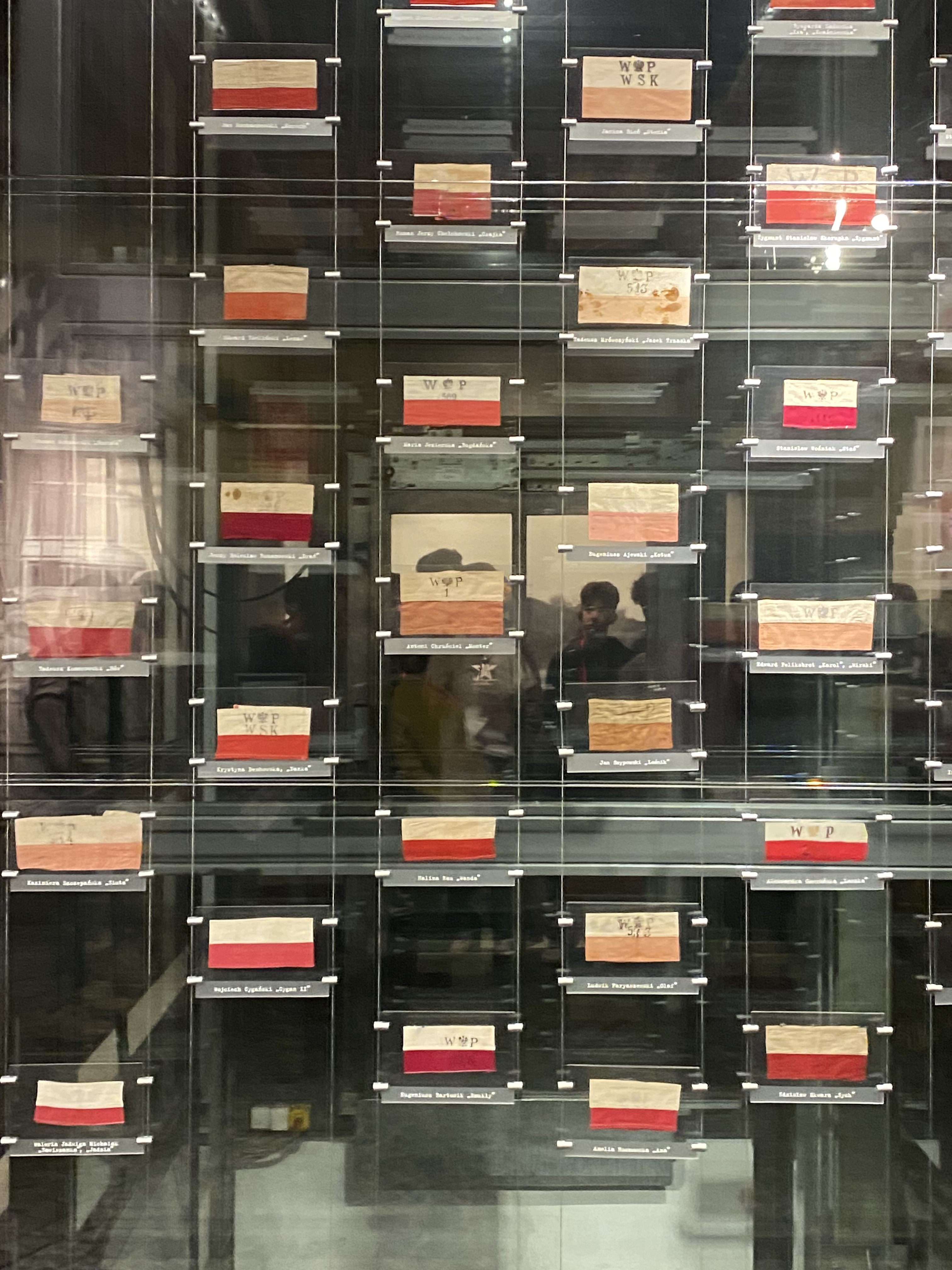
Armbands from Warsaw Rising. Photo by Hannah Pierce
Another narrative that Poles often tell about World War II is how they bravely resisted Nazi occupation. This narrative is especially strong in Warsaw, which historian Timothy Snyder calls “the center of urban resistance to Nazi rule in occupied Europe” (Snyder 280). In order to better understand the struggle against Nazi rule, my class visited the Warsaw Rising Museum. The Warsaw Rising Museum tells the story of the brave Polish people who resisted German rule in one last-ditch effort to liberate their city before the Soviets arrived. In this museum, we saw uniforms that the underground fighters wore, weapons that were used in 1944 during the uprising, and, most touching to me, a collection of armbands that the fighters used to identify each other. The scale of the suffering that the people of Warsaw endured was unbelievable. The film at the end of the museum showed an aerial view of Warsaw after the war. The entire city was leveled and turned to rubble. According to Brian Porter-Szucs, by the time the Red Army arrived in Warsaw, “at least 150,000 civilians (not counting the AK soldiers) had been killed, and nearly all of the remaining population deported out of the ruins.” (Porter-Szucs 174).

Polish soldier featured in “Nasi Chlopcy”. In Nazi and Polish Liberation Army uniforms. Photo by Hannah Pierce
However, not all Poles were as heroic as the Warsaw Uprising fighters. There were many Poles who were focused on trying to survive Nazi occupation and did not want to shelter Jews or aid Polish freedom fighters out of concern for their own safety. There were also Poles who collaborated or even fought alongside the Nazis. The exhibit in Gdansk, Nasi Chłopcy, shows photographs, drawings, and personal items of Polish young men who fought with the Germans in World War II. Here, it is worth noting that many of these young men, including the man whose photo I included here, were forced to fight for the Germans as a means of survival and ended up switching sides when the Allies liberated Poland. However, this exhibit still shows that not all Poles acted heroically during World War II, and many had a variety of different motivations. World War II was a time of great suffering for many Poles, and like across occupied Europe, there were a multitude of different reactions to this suffering, some heroic and some not.
The final dark chapter of Polish history that many Poles who are alive today have witnessed took place in the era of Soviet domination, when the country was known as the People’s Republic of Poland. Communism was a political system that was forced on the Polish people by the Soviet Union when it occupied Poland after World War II. The pre-war leaders of the Polish government were rounded up by the Soviets and were killed or forced to go abroad. Then, the Soviet Union installed its own puppet government in Poland that would be loyal to the Soviet Union and follow the Soviet Union’s ideas of communism (Institute of National Remembrance). The Polish people suffered under communism as they had also suffered during the partitions and World War II. Fear, repression, and political control ruled Poland until communism fell in 1989. Talk to any Pole or anyone who lived in Poland during communism, and they will tell you about the political repressions, censorship, the bread lines, unsafe factory conditions, and stagnant economy. This was a dark time for the majority of Poles.

MDM Square commemoration, Warsaw. Photo by Hannah Pierce
In order to learn how Poles resisted communist rule, we visited the European Solidarity Center in Gdansk, which stands on the former grounds of the Gdansk Shipyard, the site where the Solidarity social movement began. Solidarity started as a drive for unionizing shipyard workers in Gdansk, but snowballed into a movement for national liberation, counting over 10 million members at its peak in 1980 (Garton Ash 85). Under Martial Law in Poland, the trade union was shuttered, but the social movement continued to resonate with Poles tired of communist rule. In 1989, with the Round Table discussions, Solidarity members, Communist officials, and representatives of the Catholic Church were able to negotiate a peaceful end of communist rule in Poland and the first semi-free elections.

Interrogation room, European Solidarity Center, Gdansk” after the paragraph along with Photo 7 “the original plywood boards, European Solidarity Center, Gdansk. Photo by Hannah Pierce
In the European Solidarity Center, we got to see just how much heroic work it took for Solidarity and its members to get to 1989 and the fall of communism in Poland. We saw interrogation rooms and heard testimonies from the arrested Solidarity members. We got to see pictures and documents of Solidarity activists from the 1970s to 1989. We even got to see the plywood boards where the striking workers listed their demands. Referred to by journalist Andrew Higgins as “the tablets” (Higgins 1). The center does not just focus on Solidarity as a solely Polish form of heroism. It also shows people and governments from other countries who supported Solidarity either financially or politically. At the very end of the museum, visitors view a huge Solidarity sign made from thousands of small red and white cards, which invite everyone to write down what solidarity means to them today.
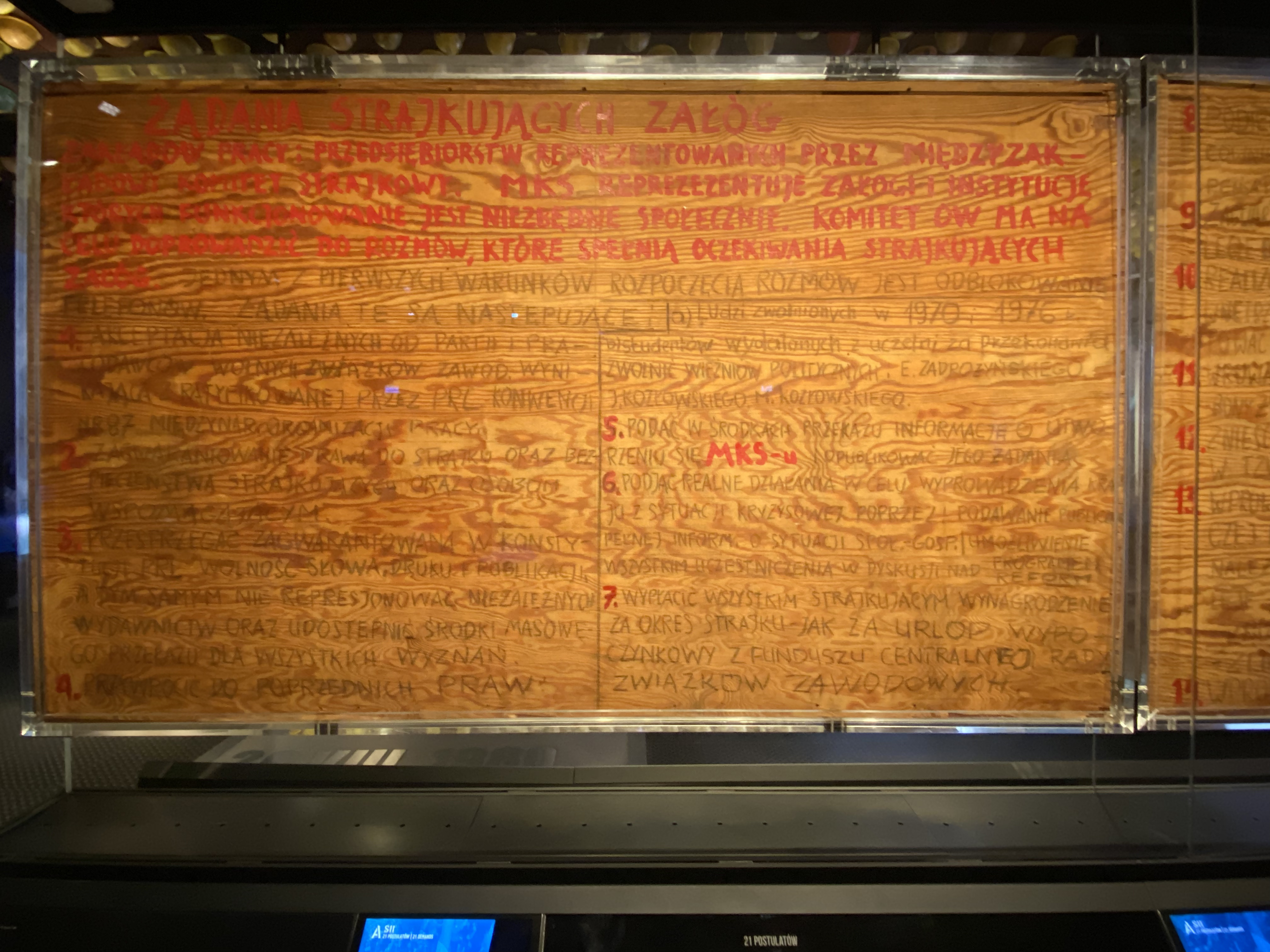
The original plywood boards, European Solidarity Center, Gdansk. Photo by Hannah Pierce
In the past ten years, the heroic actions of Solidarity members and other political activists in helping end communist rule have been muddied by divisions in Polish politics and the growth of the right-wing Law and Justice party. The legacy of Solidarity has been co-opted by Law and Justice to spew their nationalist, xenophobic, and homophobic rhetoric. As Higgins puts it, “Instead of championing freedoms, Solidarity today lobbies actively… against gay men, lesbians and anyone else it views as insufficiently respectful of the Polish nation and its traditional values” (Higgins 2). A movement that was once starkly anti-authoritarian government became increasingly aligned with an increasingly authoritarian rule by Law and Justice. The irony is not lost on many early Solidarity activists, like former president and leader of the Solidarity party, Lech Wałęsa, who rejects what Solidarity has morphed into today and wishes to preserve the movement’s original pan-European goals (Higgins 3). Poland has since voted Law and Justice out of power, but anti-immigrant sentiment and right-wing ideology remain. Without Solidarity, Poland as we know it would not exist, but the troubling surge in right-wing ideology over the past decade has threatened to co-opt Solidarity’s legacy.
Now that I have reached the end of my essay, it seems pertinent for me to try to answer my original question: “What do you think of the Polish people?” What I have arrived at is that the Polish people have had to endure a lot of suffering in their history. Whether that is being partitioned by the Habsburg, Russian, and Prussian empires and ceasing to be a nation for two hundred years, enduring Nazi occupation in World War II, or living through the repression and poverty of the communist period. It would be incorrect to say that there have not been any Poles who have stood up against this suffering in heroic ways. They fought for their nationhood first against the three big empires in the 18th and 19th centuries and then against the Nazis and the Soviets. Some hid their Jewish neighbors during the Holocaust, and openly protested against the communist system. However, this heroism in Polish history must also be balanced with an acknowledgement of the less-than-heroic things, also: serfdom, Nazi collaboration, and xenophobia, to name a few. Right now, Poland sits at a precipice. The Polish people can let right-wing political parties like Law and Justice rewrite Poland’s past and shape its future, or they can acknowledge past mistakes and work to create a better country for everyone. I believe that Poles are brave, resilient, and even heroic. The fight for their future is theirs alone, and only they can decide what kind of people they want to be seen as by outsiders like me.
Work Cited
- Garton Ash, Timothy. Homelands: A Personal History of Europe. Yale University Press, 2023.
- Higgins, Andrew. “Poles Tussle over an Icon of Their Past, with an Eye on the Future.” The New York Times, 2021, www.nytimes.com/2021/07/28/world/europe/poland-solidarity-lech-walesa.html.
- Institute of National Remembrance. “Brief History of Poland.” Institute of National Remembrance, 2025, eng.ipn.gov.pl/en/brief-history-of-poland.
- Johnson, Lonnie R. Central Europe: Enemies, Neighbors, Friends. Oxford Univ. Press, 2002.
- Porter-Szucs, Brian. Poland in the Modern World: Beyond Martyrdom. Wiley-Blackwell, 2014.
- Snyder, Timothy. Bloodlands: Europe between Hitler and Stalin. Basic Books, 2010.

