
‘Greifers’ and Extreme Means of Survival
By Sarah Vallejo
After spending almost three months now studying the history of World War II and the decades that followed in Central Europe, I would say that not much I learn shocks me anymore. I feel like I’ve “seen it all” between our lessons on the rise of the Nazi regime, our visits to three former concentration and death camps, and our walks through Gdansk, Warsaw, Prague, and more. I don’t experience the same initial surprise that I once did when learning about the horrors of those decades. And yet on our last day in Berlin, I visited the Topography of Terror Museum and encountered the first piece of new information regarding World War II that truly took me by surprise.

Topography of Terror Museum in Berlin, Germany. The open-air exhibit is in a dug-out trench along the. Photo credit: Public domain image by Adam Carr, posted on Wikipedia
The Topography of Terror is an open-air museum in Berlin with several exhibits, most notably “Berlin 1933-1945. Between Propaganda and Terror,” which covers Berlin in the Weimar Republic, the rise of the Führer’s dictatorship in Berlin, the Volksgemeinschaft or “people’s community” between the World Wars, Berlin during World War II, and Berlin during the aftermath of the war1. The exhibit’s section on Berlin during World War II is where I found myself stunned by the story of Stella Goldschlag. In the middle of the panel about German-Jewish life during the war is Stella’s brief biography. Without the yellow Star of David sewn to her clothes, Stella could have easily passed as Aryan with her blonde hair and fair looks, traits that would both save and condemn her in the later years of the war. Stella and her parents were unable to leave Berlin at the outbreak of World War II, so Stella took up work in a factory before going into hiding in 1943. Later that year, she was arrested and beaten by the Gestapo, who then threatened to send her parents to Auschwitz2. To protect her family, Stella entered “a pact with the devil” and agreed to work with the Nazis to trace down a Jewish forger she knew3. Stella, along with her Jewish husband Rolf Isaaksohn, collaborated with the Nazis from 1943 to 1945 and exposed the hiding places of numerous Jews around Berlin and greater Germany, working as a greifer or “Jew catcher”3,4. For Jews in Berlin who relied on hidden networks for safety, Stella Goldschlag emerged as a terror from within, posing as a friend while turning fellow Jews over to the Gestapo. Jews who survived the war claim that she was responsible for roughly 2000 German Jews being sent to concentration camps, as she revealed their whereabouts in an effort to save her and her family’s lives. Unfortunately for Stella, her parents were eventually sent to Auschwitz, but rather than stopping work with the Gestapo at this point, Stella remained working as a greifer. After the war, Stella attempted to register as a “victim of the Fascist state,” but many Jewish survivors recognized her when she walked into the Jewish Community offices in East Berlin to file her claims3. As was common for women who were viewed as Nazi collaborators and traitors, Stella’s hair was cut short to “de-beautify” her, and she was handed over to the police. She was convicted to ten years of hard labor in a Soviet prison for war crimes and aiding in the murder of Jews. Once released in 1956, Stella moved to West Germany and spent the rest of her life as a controversial figure before taking her own life in 1994.2

Line marking where the Berlin Wall once stood, dividing Berin into East and West Germany. After attempting to file for victim payments after the war, Stella was recognized by other Jews for her role as a greifer. She was arrested and served ten years in a Soviet labor prison, after which she moved to West Germany to live out the rest of her life. Photo credit: Sarah Vallejo
The 1992 book Stella, written by Peter Wyden who was a former classmate of Stella’s, explores Stella’s story, greifers, and Jewish life during the war through a series of interviews with Stella and other Holocaust survivors. In an LA Times article reviewing Stella, Kathleen Hendrix writes that Wyden’s account of Stella is ambiguous, rather than judgmental, leaving readers to ponder for themselves how Stella found herself in such a conflicting position3. Wyden writes that Stella claims she led the Nazis on a wild chase, “only looking for, but not finding, the forger” they hoped to capture through Stella. In her interviews, Stella held strong to the belief that she was only an onlooker as her husband caught Jews in hiding3. She saw herself exclusively “as a victim who had only tried to save herself and her family from deportation,” and she maintained this narrative until her death.4

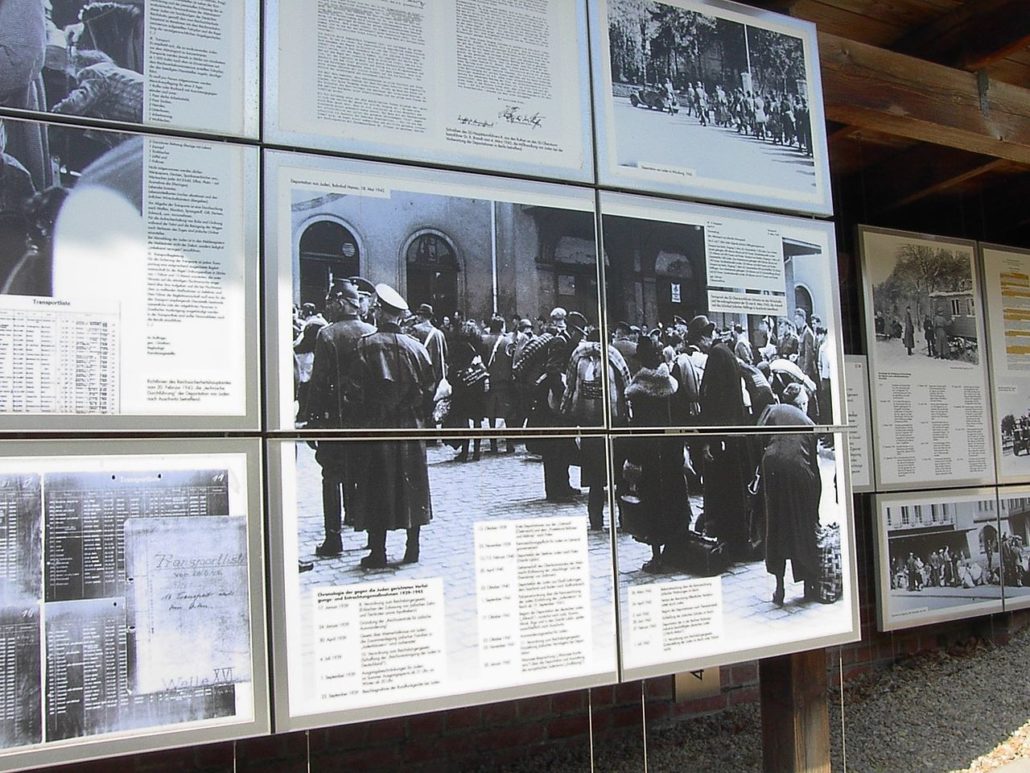
Image from the Topography of Terror Museum with a panel showing German Jews being deported to their deaths. Despite her insistence of being only an onlooker in the capturing of Jews, Stella Goldschlag was still responsible either directly or indirectly for hundreds of German Jews being sent to concentration camps and their eventual deaths. Photo credit: Public domain image by Adam Carr, posted on Wikipedia
I believe that Stella’s story stuck with me because it revealed to me the totality of terror in the Nazi order where the values of human life as we understand them today did not apply. She puts a face to the ethical complexities of trying to survive in such an unprecedented time. It’s easy to teach about the Holocaust through moral binaries of good versus evil, but coerced Jewish collaboration exists in a ‘grey zone’ between the two, as noted by scholar Primo Levi5. When talking about the grey zone, Primo Levi is primarily referring to life in concentration camps. In Hendrix’s article, she quotes Wyden and says that “the subject of Jewish collaboration – of kapos in the camps, of certain elders in the Nazi-appointed Jewish Councils in the ghettos, of random acts of betrayal – [is] ‘a taboo, an untold story, a mean subject,’”3 which underscores how these ethical complexities defy simple judgment and expose the extreme pressures imposed by a system built on terror. Stories like Stella’s disrupt our idea of morally pure narratives about World War II victims. Stella was a Holocaust survivor, but she was also responsible for thousands of German Jews being sent to concentration camps. Stella’s place in the war emphasizes a key part of Nazi terror which is that victims could be turned into collaborators and perpetrators through the Nazi’s fear tactics5. All who learn of Stella’s story are faced with the question, “How far would you go to survive?”
In Wyden’s book, another survivor and former classmate of his and Stella’s responded to this question by saying: “I’m so glad I was not tested. I wonder what anyone would do. We can’t judge”3. I think most people would like to believe that they would not do what Stella did, that they would not turn in members of their community to save themselves. But as Wyden’s classmate said, no one really knows what they will do when they must survive under such duress. Stella’s story demonstrates that under Nazi terror, survival itself could be weaponized. The Nazi regime managed to make her and her family’s lives contingent upon harming fellow Jews, turning survival into an instrument of oppression. Stella’s decision to work as a greifer reveals more about the system she was forced to live in than it does about her own morals. Her story shows how oppressive regimes can blur the line between victim and perpetrator, forcing ordinary people into roles they never could have imagined for themselves otherwise, roles that might contradict their way of being. Stella’s story reminds us that judging historical choices with the benefit of hindsight is easy, but the circumstances of the “choices” she made were not black-and-white. She lived in a more complicated reality than we can imagine. To quote the name of the museum, Stella lived in “a topography of terror.” She lived in a world where modern standards of logic, empathy, and democracy did not apply, therefore her means of survival cannot be judged by our modern expectations of ethics and morality. When trapped in a situation with only bad options, it’s hard to say how any of us would act, especially if our goal is to survive.
Sources
- “Berlin 1933–1945. Between Propaganda and Terror” Topographie Des Terrors, topographie.de/en/exhibitions/berlin-1933-1945.
- Topography of Terror Museum. Berlin, Germany. Visited November 11, 2025.
- Hendrix, Kathleen. “Saga Peter Wyden and Stella Goldschlag…” Los Angeles Times, 21 Dec. 1992, latimes.com/archives/la-xpm-1992-12-21-vw-1721-story.html.
- Jockusch, Laura. The Trials of Stella Goldschlag: Nazi Victim, Holocaust Survivor, and War Criminal. https://hef.northwestern.edu/lessons-and-legacies-conference/ll-pdfs/jockusch.pdf.
- Craps, Stef. “The Grey Zone.” Témoigner. Entre Histoire et Mémoire, no. 117, 1 Oct. 2014, pp. 202–203, https://doi.org/10.4000/temoigner.1266.
- Carr, Adam. Topography of Terror – Berlin Wall. 2006. Wikipedia, Wikimedia Commons, en.wikipedia.org/wiki/File:Topography_of_Terror_-_Berlin_Wall.JPG.
- Carr, Adam. Topography of Terror – Berlin Jews Deported. 2006. Wikipedia, Wikimedia Commons, en.wikipedia.org/wiki/File:Topography_of_Terror_-_Berlin_Jews_deported.jpg.

